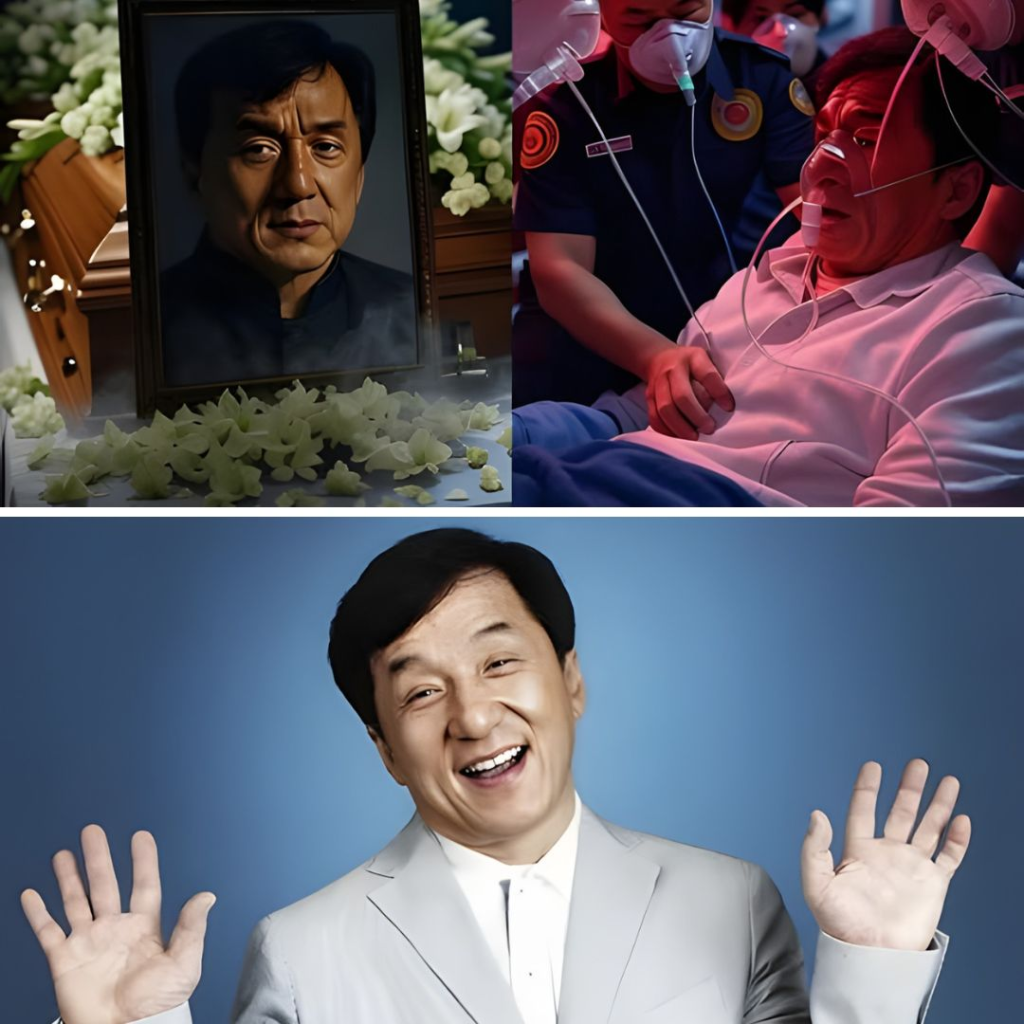
Fifteen minutes ago, the world stopped breathing. The name “Jackie Chan,” once synonymous with laughter, courage, and impossible stunts, is now trending for the most devastating reason imaginable. According to early police reports from Guangxi, China, the legendary actor suffered a serious on-set accident while filming his latest action film, Dragon Soul.
Eyewitnesses say Jackie fell from a height of nearly 10 meters during an aerial stunt that he insisted on performing himself — as he always had for five decades. Despite immediate medical attention, multiple attempts to save him reportedly proved unsuccessful. Within minutes, the news sent shockwaves through the entertainment world.
If confirmed, this would mark the end of an era — not just for cinema, but for an entire philosophy of filmmaking built on sweat, discipline, and fearlessness.
The Moment Everything Changed
The accident occurred just after midnight. Crew members say Jackie had been rehearsing a complex wire-assisted sequence — a leap from a collapsing pagoda onto a narrow platform below, followed by an explosion. The first take went perfectly. But Jackie, known for his perfectionism, wanted another shot.
That decision may have cost him his life.
A production assistant, still trembling, recalled, “He said, ‘Let’s do it again, I can make it smoother.’ The next second, the wire jerked violently. He lost his balance and fell.”
The set fell silent. Crew members rushed to him, shouting his name. Paramedics were called immediately. He was rushed to a nearby hospital but was reportedly unresponsive upon arrival. Police have launched an investigation into whether safety negligence or faulty equipment played a role.
A Lifetime of Risk — and Art
For Jackie Chan, danger was never a choice; it was part of his language. His career was built on real pain — bruises, broken bones, concussions, all turned into cinematic poetry. He once said, “When you see me fall, that’s not acting. That’s real. But if it makes people laugh or cheer, then it’s worth it.”
From Drunken Master to Police Story, Project A, and Rush Hour, Jackie created a genre that defied definition — equal parts kung fu, comedy, and chaos. He didn’t just perform stunts; he humanized them. Each misstep, each grimace, each gasp became part of a story about imperfection and perseverance.
Where Western heroes conquered effortlessly, Jackie struggled, failed, bled, and got up again. That vulnerability made him universal — the underdog who could take a punch and still smile.
Critic David Bordwell once wrote: “Jackie Chan redefined screen heroism. He showed that courage isn’t the absence of fear — it’s laughing through it.”
An Artist of Pain and Precision
Jackie’s physical courage was only part of the story. Beneath his wild acrobatics lay a perfectionist obsessed with rhythm, timing, and beauty in movement. Every jump was choreographed like a dance, every punch timed to the beat of invisible music.
Portable speakers
A Global Icon — East and West United
What made Jackie Chan so extraordinary was not just his endurance but his universality. He became a cultural bridge between East and West, reshaping how the world viewed Asian performers.
In Hollywood, he faced early rejection — told that his accent, his height, and his age were “not marketable.” But Jackie refused to conform. He didn’t want to be another Bruce Lee imitation; he wanted to be himself — clumsy, funny, mortal. When Rush Hour (1998) became a global hit, he achieved something rare: he made the world laugh in two languages at once.

Jackie’s comedy was silent-film genius reborn — inspired by Chaplin and Keaton, but rooted in Chinese discipline. He could turn a chair, a ladder, or even a refrigerator into a weapon of beauty. Through him, martial arts became storytelling, not violence.